Can AI Really Measure Blood Pressure from Your Face? The Science Behind SmartVitals Explained

For decades, measuring blood pressure meant one thing – a cuff wrapped tightly around your arm. Whether at a clinic, pharmacy, or home, traditional blood pressure monitors have always required physical contact.

But today, with rapid advancements in artificial intelligence and computer vision, a revolutionary question is being asked:

Can AI really measure blood pressure just by scanning your face?

It may sound futuristic. It may even sound unbelievable.
But the science behind AI-powered face scan technology is real – and it’s already strengthening preventive healthcare through innovations like SmartVitals by MyDigiRecords (MDR).

Let’s break down the science, the accuracy, the myths, and what this means for the future of health monitoring in India and beyond.

Smartvitals BP Measurement

The Problem: Why Traditional Blood Pressure Monitoring Often Falls Short

Before understanding AI-based monitoring, we must address a serious issue: many people in India do not monitor their blood pressure regularly — often because they avoid checkups, don’t own a BP machine, measure incorrectly at home, or only test when symptoms appear.

The result? Silent hypertension.
High blood pressure is often called a “silent killer” because it shows no obvious symptoms until it causes serious damage — stroke, heart attack, kidney disease.

Traditional BP monitoring also has practical limitations:

  • Requires equipment
  • Needs proper positioning and technique
  • Can be affected by anxiety (“white coat syndrome”)
  • Isn’t convenient for daily tracking for many people

This is where AI-powered contactless monitoring enters the picture.

How Can AI Measure Blood Pressure from a Face?

AI can’t “see” blood pressure directly from your face. Instead, it analyzes a short facial video to detect tiny, time-based changes in skin color caused by blood flow with each heartbeat. Machine-learning models trained on large datasets (matched with verified BP readings) learn these patterns and use them to estimate blood pressure.

This results in an estimate that is typically most useful for tracking patterns and trends over time, rather than treating a single scan as a definitive clinical reading.

Let’s simplify that.

When your heart beats, blood flows through vessels beneath your skin. This blood flow causes tiny color changes on your face — invisible to the human eye, but detectable by advanced AI algorithms through your smartphone camera.

AI models can analyze signals linked to:

  • Subtle facial color variations
  • Micro blood flow patterns
  • Pulse-related signals
  • Heart rhythm patterns

From these data points, machine learning models can estimate:

  • Heart rate
  • Blood pressure trends
  • Stress/wellness insights
  • Oxygen saturation (in some systems)

This isn’t magic. It’s mathematics + signal processing + artificial intelligence.

The Role of AI & Machine Learning

AI doesn’t “see” your face the way humans do. Instead, it processes video frame-by-frame (typically around 30–60 frames per second on most smartphones) and compares patterns against trained datasets.

Over time, machine learning algorithms can:

  • Learn correlation patterns between facial signals and cardiovascular metrics
  • Improve prediction accuracy
  • Adapt better across different skin tones and lighting conditions
  • Filter noise and environmental disturbances

This is also why lighting, movement, and camera quality can impact results.

Introducing SmartVitals by MyDigiRecords

Now let’s talk about how this innovation is implemented practically.

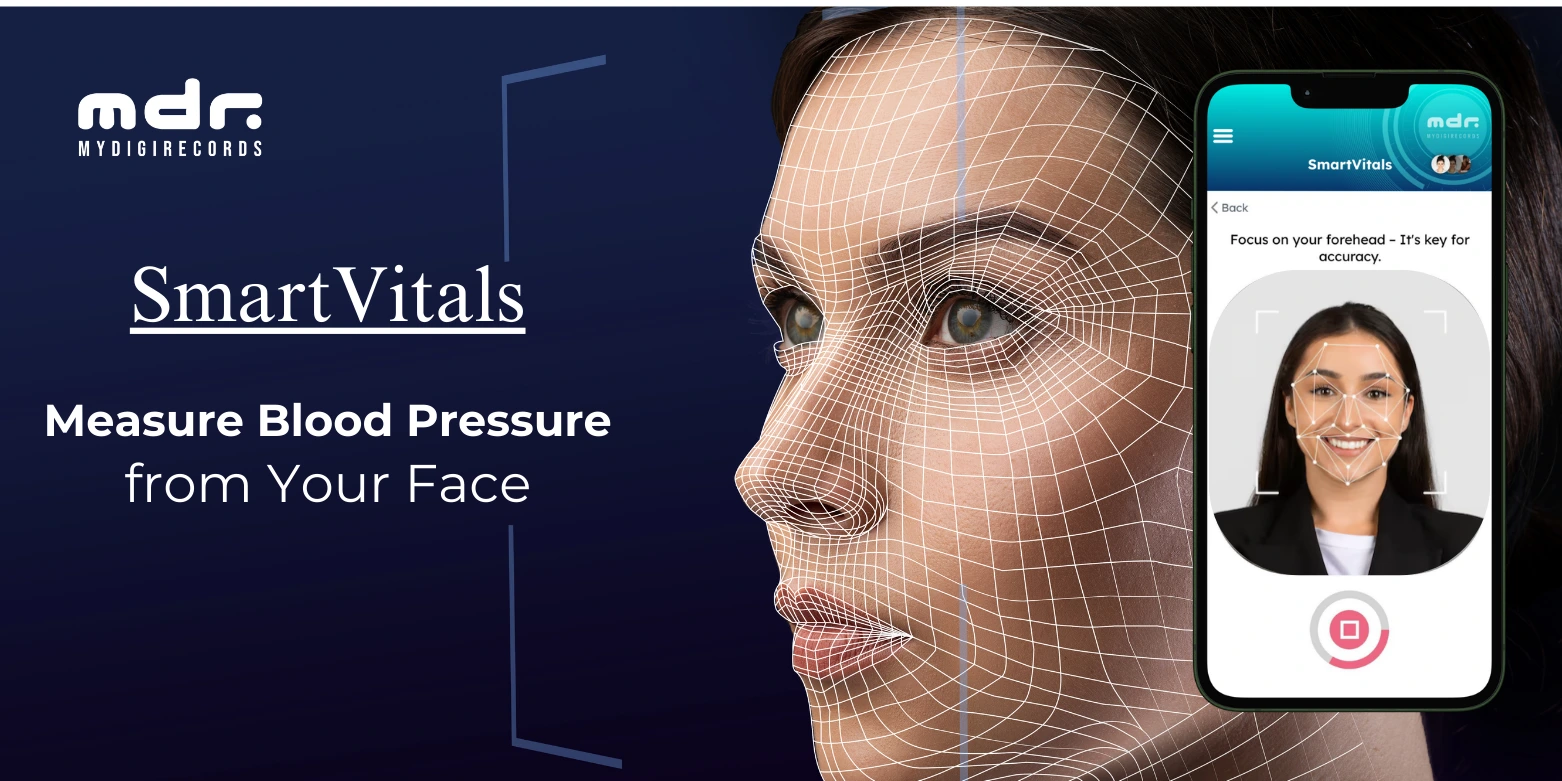
SmartVitals, a powerful module inside the MyDigiRecords (MDR) app, uses AI-powered facial scanning technology to provide users with health metrics in seconds.

All you need to do is:

  1. Open the MyDigiRecords app
  2. Activate SmartVitals
  3. Look at your phone camera for a few seconds
  4. Stay still while scanning

Within moments, you receive insights such as:

  • Heart rate estimation
  • Blood pressure trend insights
  • Stress/wellness insights
  • Additional wellness metrics (as supported by the system)

This transforms your smartphone into a personal health monitoring tool.
No cuff. No wires. No clinic visit.
Just AI + your camera.

(Results can vary based on lighting, movement, and real-world conditions — so it’s best used consistently over time.)
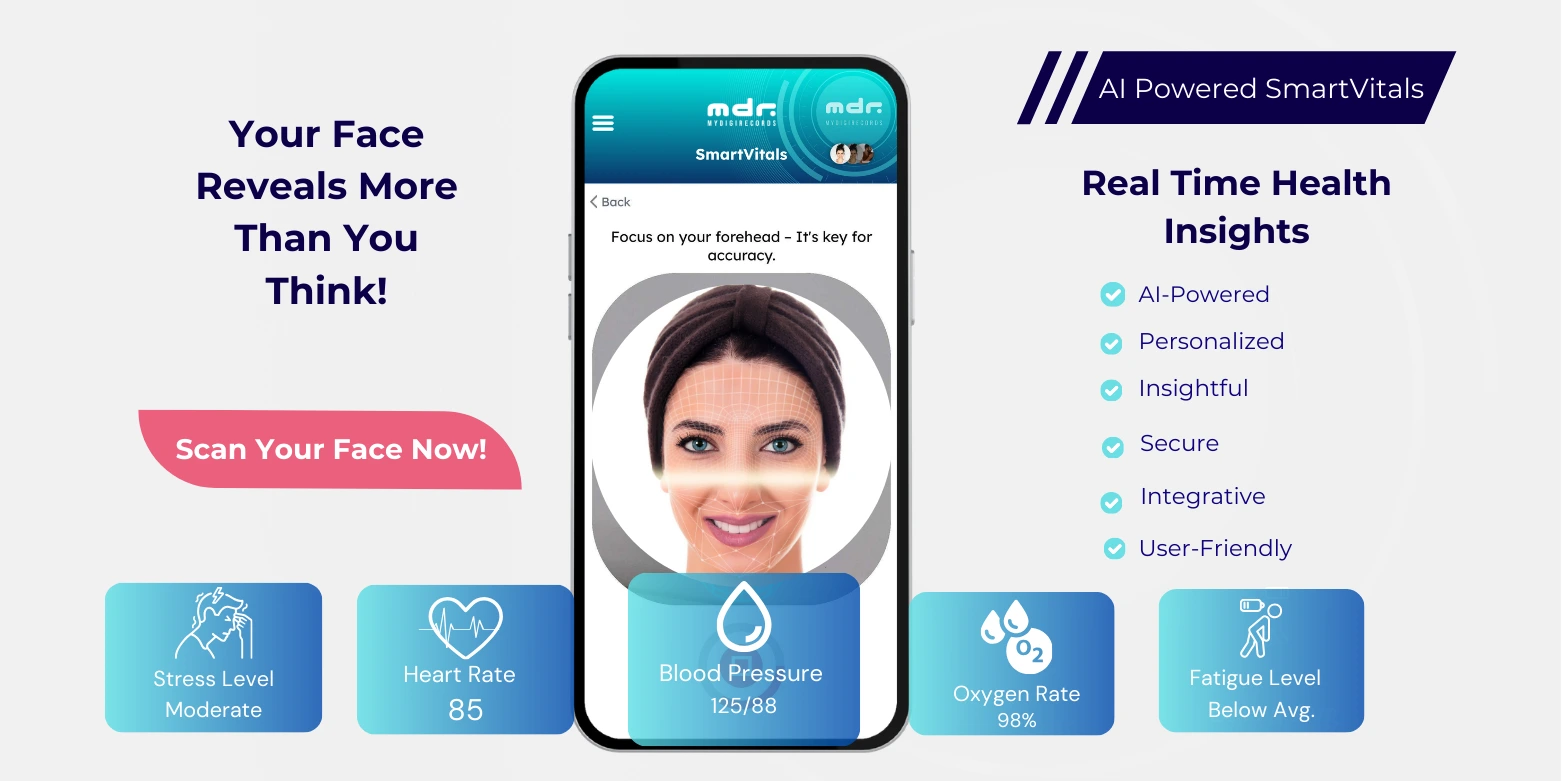

SmartVital Features

Is AI Blood Pressure Monitoring Accurate?

This is the most important question.

AI-based monitoring is not meant to replace clinical diagnostic equipment in emergency situations. However, evidence and real-world deployments show that AI-powered technology can be useful for trend-based monitoring, especially when used consistently over time.

It is especially helpful for:

  • Daily health tracking
  • Preventive monitoring
  • Early risk detection
  • Lifestyle management

The strength of AI monitoring lies in trend tracking, not single-point diagnosis.

For example: if your blood pressure trend is gradually increasing over weeks, SmartVitals can help flag the change early — long before you experience symptoms. That’s the power of preventive healthcare.

If you need diagnosis, medication changes, or emergency decisions, a validated BP device and a clinician’s guidance remain the standard.

Why Contactless Monitoring Is the Future

Contactless health monitoring is gaining momentum globally because it offers:

  1. Convenience — no device setup required
  2. Accessibility — anyone with a smartphone can monitor basic vitals
  3. Hygiene — no shared equipment, especially important post-pandemic
  4. Remote monitoring support — useful for elderly family members or busy working professionals

In a country like India where healthcare access varies widely, smartphone-based AI health tracking can bridge major gaps. It can also encourage routine monitoring habits — one of the biggest missing pieces in preventive care.

SmartVitals + MyDigiRecords: A Powerful Combination

Monitoring is powerful. But storing and organizing health data is equally important.

This is where MyDigiRecords stands out from many health tracking apps. Most apps show data temporarily. MyDigiRecords goes further by helping you:

  • Store medical reports
  • Upload prescriptions
  • Organize lab results
  • Maintain family medical history
  • Share records instantly with doctors

Now imagine combining:

AI-powered vital monitoring (SmartVitals)

WITH

Secure digital health record storage (MyDigiRecords)

That’s a complete digital health ecosystem — where your health information is centralized in one secure place instead of scattered across WhatsApp, PDFs, and folders.

How This Helps Indian Families

Imagine:

  • A 45-year-old professional checking BP trends daily before work
  • A diabetic patient tracking heart rate patterns
  • Parents monitoring elderly family members remotely
  • Students managing stress during exams

Instead of waiting for a clinic visit, health insights become daily habits.

And when visiting a doctor, you can:

  • Share long-term BP trends
  • Show historical health reports
  • Provide accurate medical history instantly

Doctors make better decisions when they have better data.

Data Privacy & Security: Is It Safe?

Health data is sensitive. That’s why MyDigiRecords focuses strongly on:

  • Secure storage
  • Encrypted data systems
  • Controlled access sharing
  • User-controlled data permissions

Your health records are not scattered across messaging apps or random folders. They are stored in one protected environment.

In today’s digital world, security is as important as innovation.

Limitations of AI-Based Monitoring

To maintain transparency, it’s important to understand limitations:

  • It requires good lighting conditions
  • Excessive movement can reduce accuracy
  • It does not replace emergency medical equipment
  • Severe cardiovascular conditions require clinical validation
  • Skin tone diversity, camera quality, and environmental lighting can affect accuracy – so consistency and proper scan conditions matter

AI monitoring is best used as a preventive and supplementary tool, not a replacement for professional medical diagnosis.

The Future Is Already Here

So, can AI really measure blood pressure from your face?
AI can estimate blood-pressure-related trends by analyzing subtle blood-flow signals captured in a short facial video – but it should be treated as a supportive, preventive tool, not a clinical replacement.

But the real innovation isn’t just measurement. It’s integration.

SmartVitals + MyDigiRecords create a powerful ecosystem where:

  • Monitoring meets organization
  • Technology meets prevention
  • Data meets action

The future of healthcare is not just smarter. It’s more accessible, more connected, and more proactive. And with tools like SmartVitals inside MyDigiRecords, that future is already in your hands.

Download MyDigiRecords today. Use SmartVitals. Know your numbers. Live better.

FREQUENTLY ASKED QUESTIONS (FAQs) ABOUT PHR APPS

Can AI really measure blood pressure from a face scan?

AI analyzes a short facial video to detect subtle blood-flow-related signals and uses machine-learning models to estimate blood pressure trends (rather than treating it like a cuff-based clinical measurement).

Is SmartVitals medically approved?

SmartVitals is designed for wellness monitoring and trend tracking. It does not replace clinical diagnostic devices in emergency situations.

How accurate is face scan blood pressure monitoring?

It is effective for tracking patterns and trends over time. For medical emergencies or precise diagnosis, traditional equipment is recommended. Accuracy can vary with lighting, motion, and device camera quality - stable conditions improve reliability.

Is my health data safe in MyDigiRecords?

MyDigiRecords uses secure storage systems with encrypted data handling and user-controlled sharing options.

  • PHR is managed by the patient and includes information that the individual gathers, such as home health data, immunizations, and personal notes.
  • EMR, on the other hand, is maintained by healthcare providers and focuses on the clinical data collected during patient visits, such as diagnoses, treatment plans, and prescriptions. The main difference is that PHR gives the individual full control over their health information, while EMR is managed by healthcare professionals.

Who should use SmartVitals?

Working professionals, elderly individuals, fitness enthusiasts, patients managing hypertension trends, and families wanting organized digital medical records.

More blogs for you to read